


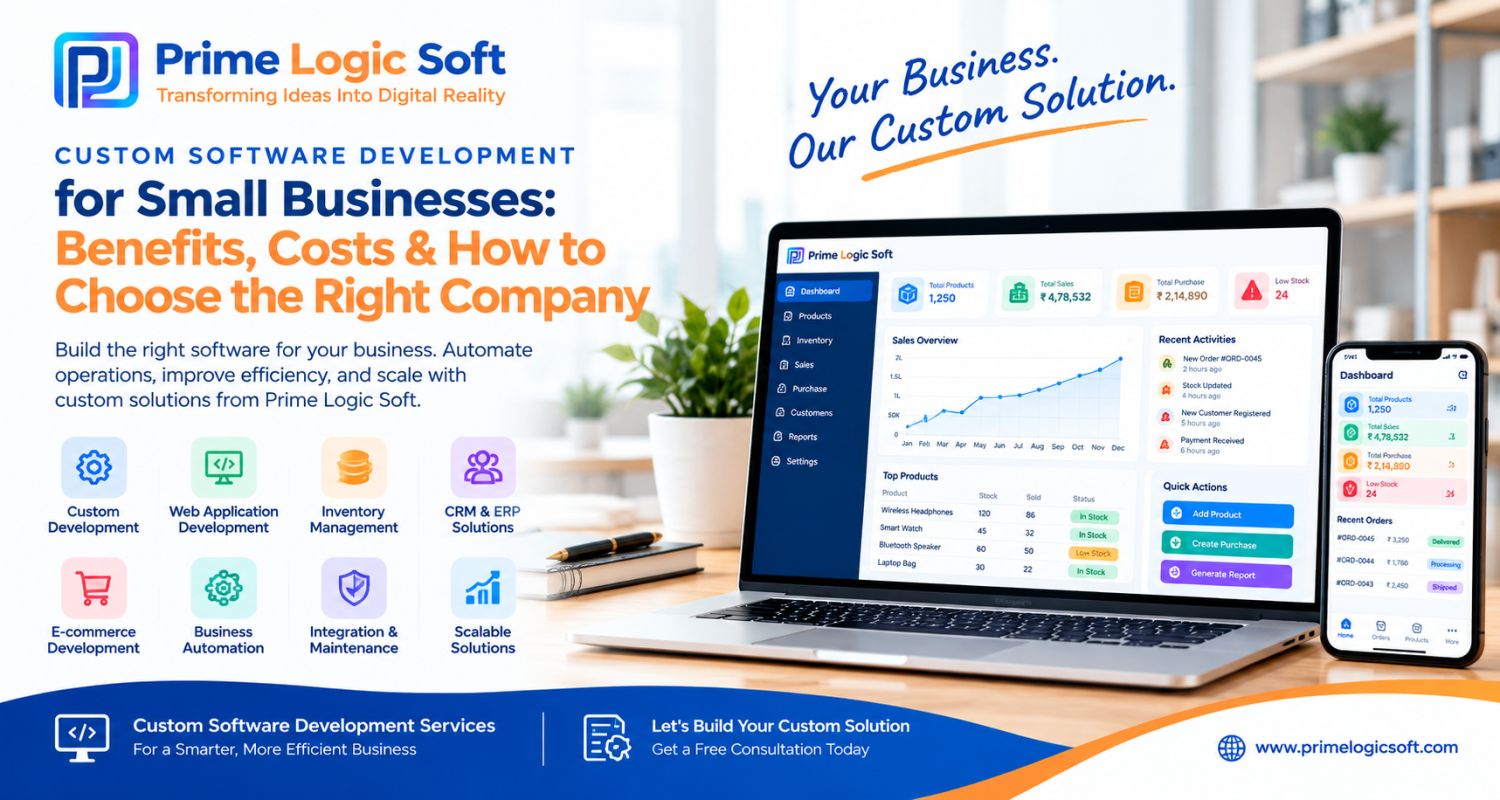
Custom Software Development for Small Businesses: Benefits, Costs & How to Choose the Right Company
Small businesses today need more than just a website to compete in the digital marketplace. They need reliable technology solutions that help manage daily operations, automate business processes, improve customer experiences, and increase productivity.
This is where custom software development for small businesses becomes important.
Whether you run a retail store, manufacturing company, wholesale business, distribution company, or service-based organization, the right software can simplify your operations and help your business grow.
In this guide, we will explore the benefits of custom software development, different types of business software, development costs, and how to choose the right software development company.
What Is Custom Software Development?
Custom software development is the process of designing and building software specifically according to a business's requirements.
Unlike ready-made software, which offers general features for multiple users, custom software is developed to address your organization's unique workflows, processes, and business goals.
For example, a business may need:
-
Inventory and stock management software
-
Customer Relationship Management (CRM) software
-
Enterprise Resource Planning (ERP) software
-
Billing and invoicing applications
-
Employee management systems
-
E-commerce websites and applications
-
Business automation solutions
-
Custom web applications
A custom solution allows businesses to manage their operations from a centralized platform and reduce dependency on multiple disconnected tools.
7 Benefits of Custom Software Development for Small Businesses
1. Designed According to Your Business Requirements
Every business has different processes and requirements. Ready-made software may include unnecessary features or lack important functionality.
Custom software is developed around your business workflow, making it easier for employees to perform their daily tasks.
2. Improved Business Productivity
Manual business processes consume time and increase the possibility of errors.
With custom software, businesses can automate repetitive tasks such as data entry, invoice generation, stock updates, customer management, and reporting.
This allows employees to focus on more important business activities.
3. Better Inventory and Business Management
Managing inventory, sales, purchases, and customer records manually can become difficult as a business grows.
An inventory management system helps businesses:
-
Track available stock in real time.
-
Manage purchase and sales transactions.
-
Monitor low-stock products.
-
Generate inventory reports.
-
Manage warehouses and product categories.
-
Reduce stock discrepancies.
A centralized inventory system provides better visibility and control over business operations.
4. Scalability for Future Growth
Your software should grow with your business.
Custom software can be expanded by adding new features, integrating additional services, and supporting more users as your business requirements change.
This makes it a suitable long-term investment for growing organizations.
5. Better Data Security and Access Control
Business data is valuable. Custom applications can include role-based access, user permissions, secure authentication, and data backup mechanisms.
These features help businesses manage sensitive information and control who can access different sections of the application.
6. Integration With Other Business Tools
Businesses often use multiple applications for payments, accounting, communication, reporting, and customer management.
Custom software can integrate with relevant third-party services and APIs to create a more connected business environment.
7. Long-Term Cost Efficiency
Although custom software may require an initial investment, it can reduce recurring subscription costs, manual work, and operational inefficiencies over time.
Businesses can invest in the features they actually need instead of paying for unnecessary functionality.
Custom Software vs. Ready-Made Software
Before choosing a software solution, it is important to understand the differences between custom-built and ready-made applications.
| Feature | Custom Software | Ready-Made Software |
|---|---|---|
| Development | Built for specific requirements | Pre-built solution |
| Customization | Highly customizable | Limited customization |
| Scalability | Can grow with your business | Depends on provider |
| Features | Based on business needs | Standard features |
| Integration | Can be developed as required | Depends on available integrations |
| Initial Cost | Generally higher | Often lower |
| Flexibility | High | Limited by product capabilities |
Which option is better?
Ready-made software can be a good choice for businesses with standard requirements and limited budgets.
Custom software is more suitable when your business needs specific workflows, advanced integrations, unique features, or greater flexibility.
Types of Business Software Every Growing Company Should Consider
Different businesses require different software solutions. Here are some common types of applications that can improve business operations.
1. Inventory Management Software
Inventory management software helps businesses track products, purchases, sales, stock levels, and warehouse operations.
It is especially useful for retailers, wholesalers, distributors, and manufacturers.
2. CRM Software
Customer Relationship Management software helps businesses manage customer information, leads, sales activities, communication, and follow-ups.
It improves customer relationships and helps sales teams manage their pipelines.
3. ERP Software
Enterprise Resource Planning software connects different business departments through a centralized platform.
It can include inventory, accounting, HR, purchasing, sales, and reporting modules.
4. E-commerce Software
E-commerce applications allow businesses to sell products online, manage orders, accept payments, and handle customer information.
5. Business Automation Software
Business automation software reduces manual work by automating repetitive tasks, notifications, approvals, reports, and business workflows.
6. Custom Web Applications
Custom web applications are developed to solve specific business problems and can be accessed through a web browser.
Examples include booking systems, management portals, reporting dashboards, and customer portals.
How Much Does Custom Software Development Cost?
The cost of custom software development depends on several factors.
There is no fixed price because every project has different requirements, functionality, and complexity.
Some important factors affecting development costs include:
-
Project complexity: A simple business application generally costs less than a large enterprise system.
-
Number of features: Additional modules and functionality increase development effort.
-
UI/UX design: Custom interfaces and user experiences require additional design work.
-
Technology stack: The technologies and infrastructure selected can influence the overall cost.
-
Third-party integrations: Payment gateways, APIs, accounting tools, and other integrations can add complexity.
-
Maintenance and support: Regular updates, security improvements, and technical support should also be considered.
The best approach is to discuss your business requirements with a software development company and request a customized project estimate.
How to Choose the Right Software Development Company
Choosing the right development partner is important for the success of your project.
Consider the following points before making a decision:
1. Understand Their Experience
Check the company's experience in developing business applications, websites, management systems, and software solutions.
2. Review Their Portfolio
Look at previous projects to understand their development quality, design capabilities, and technical expertise.
3. Check Technology Expertise
Choose a company that understands modern development technologies and can recommend the right technology for your project.
4. Discuss Your Requirements Clearly
A reliable development company should understand your business goals and suggest practical solutions rather than simply offering generic software.
5. Consider Support and Maintenance
Software development does not end after deployment. Choose a company that can provide ongoing maintenance, updates, and technical assistance.
6. Compare Value, Not Just Price
The lowest development quote is not always the best option. Consider software quality, scalability, security, support, and long-term business value.
Why Choose Prime Logic Soft for Custom Software Development?
Prime Logic Soft helps businesses improve their operations through technology-driven software solutions.
We focus on understanding business requirements and developing solutions that support operational efficiency, productivity, and long-term growth.
Our services include:
-
Custom software development
-
Web application development
-
Inventory management software
-
Business management solutions
-
CRM and ERP development
-
E-commerce development
-
Business process automation
-
Software integration and maintenance
Whether you are starting a new business application or upgrading an existing system, our team can help you identify the right technology solution.
Looking for an inventory management solution?
Explore our inventory management platform:
https://inventory.primelogicsoft.com/login
Visit our website to learn more about our software development services:
Frequently Asked Questions (FAQs)
1. What is custom software development?
Custom software development is the process of building applications specifically according to the requirements, workflows, and goals of a particular business.
2. Is custom software suitable for small businesses?
Yes. Custom software can help small businesses automate operations, manage customers, track inventory, reduce manual work, and improve productivity.
3. How long does custom software development take?
Development time depends on project complexity, features, integrations, and testing requirements. Small applications may take a few weeks, while complex systems can take several months.
4. What technologies are used for custom software development?
Common technologies include PHP, Laravel, Node.js, JavaScript, MySQL, PostgreSQL, and other modern frameworks and tools. The right technology depends on the project requirements.
5. Can custom software integrate with existing business systems?
Yes. Custom applications can integrate with existing systems through APIs and other supported integration methods.
6. Is custom software better than ready-made software?
It depends on your business requirements. Ready-made software is useful for standard needs, while custom software offers more flexibility and control over specific business processes.
7. Does custom software require regular maintenance?
Yes. Regular maintenance helps keep software secure, updated, reliable, and compatible with changing business requirements.
Conclusion
Custom software development can help small businesses simplify operations, improve productivity, reduce manual work, and prepare for future growth.
From inventory management and CRM to ERP systems and business automation, the right technology can make a significant difference in how efficiently your organization operates.
The key is to choose a solution that matches your business requirements and a development partner that understands your goals.
Ready to take your business to the next level?
Contact Prime Logic Soft today to discuss your custom software development requirements and explore the right technology solution for your business.
Website: https://primelogicsoft.com/